Research themes

Below are listed some of my main research topics, with links to relevant papers that I have been involved in.
(Note, some papers belong to more than one topic and therefore appear more than once).
|
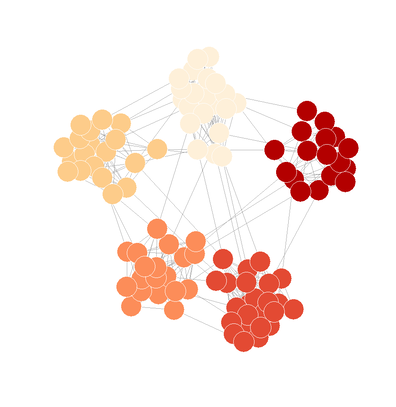
The role of trait preferences in the emergence of social network structures Social preferences for traits are behaviours where individuals prefer others with certain characteristics (age, sex, etc.) as social partners. Such preferences play an important role for social network structures, both in humans and non-human animals. To understand the emergence and consequences of social structures, is therefore important to understand how different trait-based social preferences affect network structure and function.
|
|
|
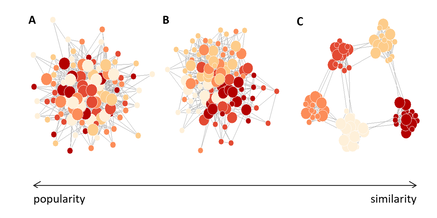
Generative network modelling for understanding social systems Generative network models are algorithms that can create simulated networks structures. They constitute a key approach in the study of networks. We have developed generative network models to investigate various topics concerning social structures.
|
|
|
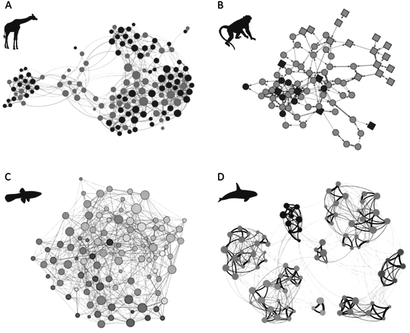
Strengthening the connection between behavioural ecology and network science/complex systems As a researcher working across different fields, I work for strengthening interdisciplinary connections and knowledge sharing.
|
|
|
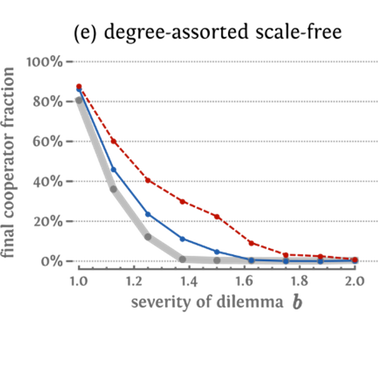
The evolution of cooperation in structured populations How can cooperative behaviour evolve and survive? This question is of great scientific interest across disciplines, and social network structure plays an important role in answering it. We have investigated the evolution of cooperation in structured populations both with computer simulations and data from wild populations of guppies, a classic model species for social behaviour research.
|
|
Network analysis methodology
See above for generative network modelling.
See above for generative network modelling.
- Comparative network analysis: see this paper (lead by Delphine De Moor)
- Layers of latency - a conceptual framework for network analysis: see this paper (lead by Delphine De Moor)
Social structures and communication
Social relationships are closely intertwined with communication between individuals. The social networks approach provides new opportunities to study this connection.
- Theme issue on how vocal communication is linked to social networks and collective behaviour: see the introduction here (lead by Elodie Briefer)
- A review exploring how vocalizations shape group dynamics: See this paper (lead by Bing Xie)
- Knowing friend from foe: recognition of nestmates in ants: See this paper (lead by Jelle van Zweden)
Temporal dynamics of social network structures
- Social network stability and variation in giraffes: see this paper (lead by Steffen Prehn)
Social preferences and conflict over reproduction
- Social preferences can reduce detrimental consequences of conflict over reproduction: see this paper
